Please excuse the radio silence – more graft in forming a publishing business than anticipated – but we’re getting there!
We hoped to be publishing our first three books this September, but were pipped at the post by an established publishing house for Alex Hubbard’s debut novel Storm. We wish Alex well with Storm – it’s a mighty good read!
However, we remain on schedule to publish two important texts
I Zig and I Zag – Poetry Anthology
Masaka Madeda, Eric Ngalle Charles, Brân Denning, Ciel Saludes, Luke A. Blaid, Rosamund McCullain, Mohammed Abdoel, Gareth Alun Roberts, Rakyah Assam, and GI James.
This poetry anthology, featuring thirteen poems by nine British poets, is followed by an epic poem by Kenyan poet Masaka Madeda. The two worlds are markedly distinct. The anthology’s opening presents poems from marginalised writers, interlacing darker myths, memories, and landscapes into lyrical explorations of identity, loss, and transformation. This stark contrast is further emphasised by the epic poem. Click to Preorder
Love and Happiness – a Novel by GI James
In the 1970s Cheshire, Harriet Bush, a mixed-race schoolgirl and adoptee, grapples with her identity, family secrets, and the tragic death of a schoolmate. This novel explores important social and cultural issues that are still relevant today, particularly those related to belonging.
The story, told in an intriguing and captivating narrative, begins with Harriet’s childhood perspective and gradually hardens as we witness her journey into adulthood. Shaped by her experiences as a mixed-race adoptee in a predominantly white environment, Harriet confronts themes including race and racism, adoption, alcohol abuse, end-of-life care, the challenges faced by mothers in the social care system, misogyny, and suicide. Click to Preorder
Open for Submissions
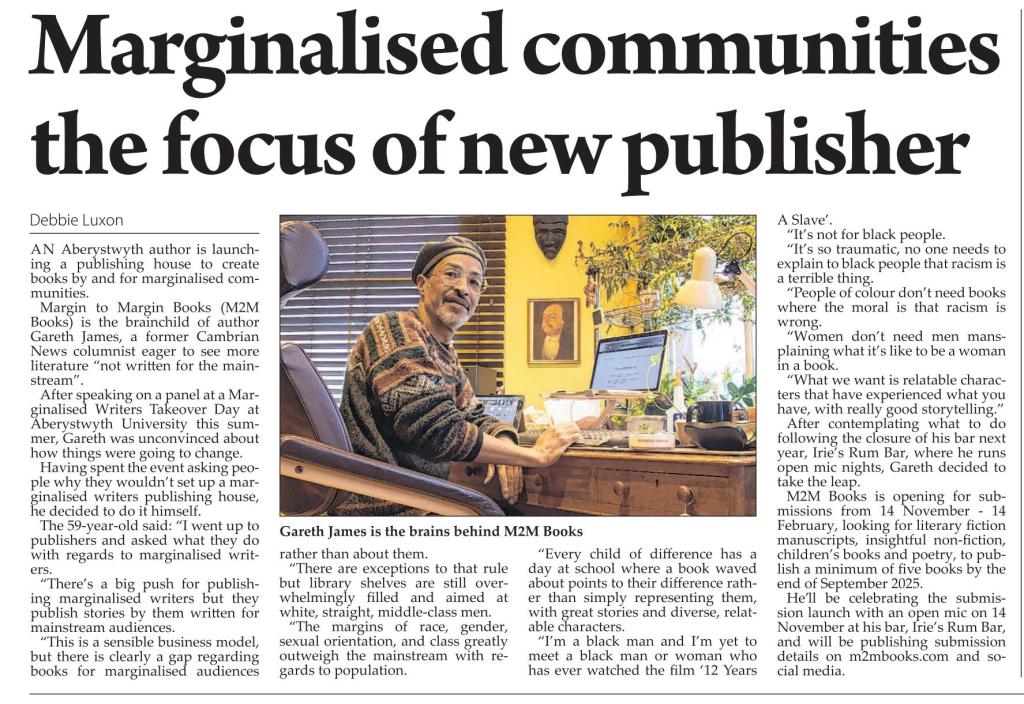
M2M Books remains open for submissions.









 Margin to Margin Books