At Margin to Margin Books, we’ve always believed that the most compelling stories are not found in the well-trodden centre, but at the edges; in the margins where identity, culture, and creativity collide. As a newly established independent press based in the heart of Mid Wales, our mission is to provide a permanent home for these voices, ensuring they are heard on their own terms.
M2M Books do not believe in tokenistic diversity calendars or trauma-mining narratives. We believe in excellent literature. Today, we are looking for partners in the literary community to help us share that vision.
To celebrate our inaugural titles, we are opening up a number of review slots for reviewers, bloggers, Bookstagrammers, and BookTokers who share our passion for diverse voices and literary excellence.
Debut Titles
We are seeking reviews for:
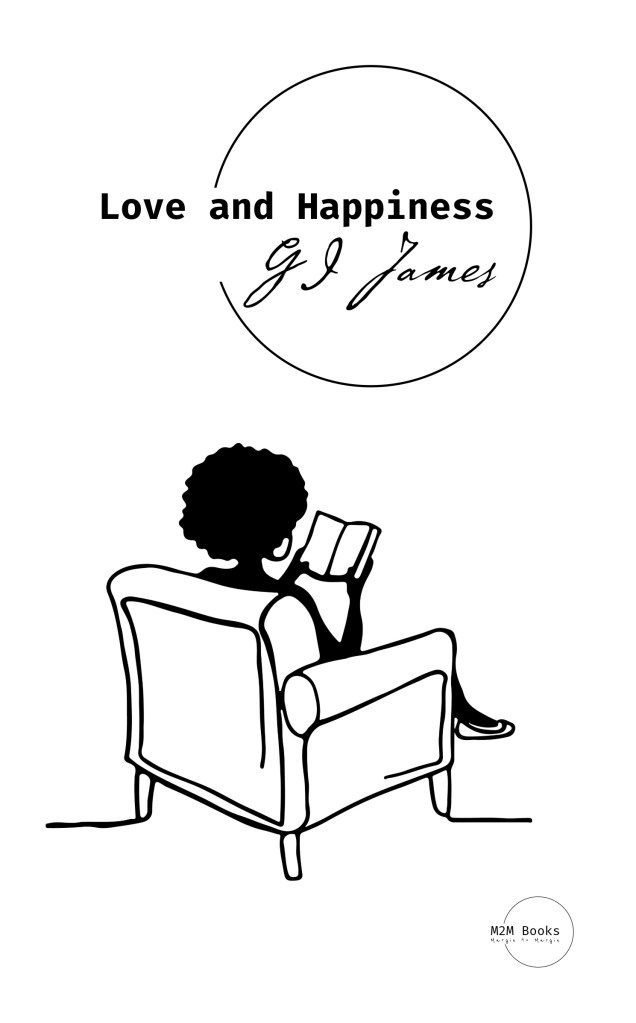
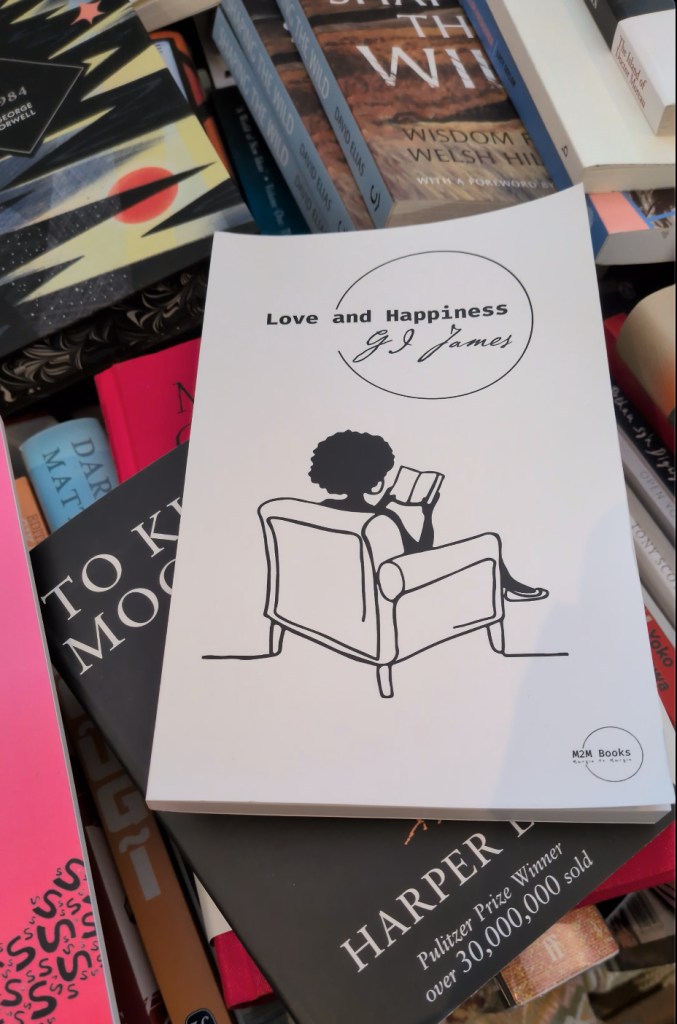
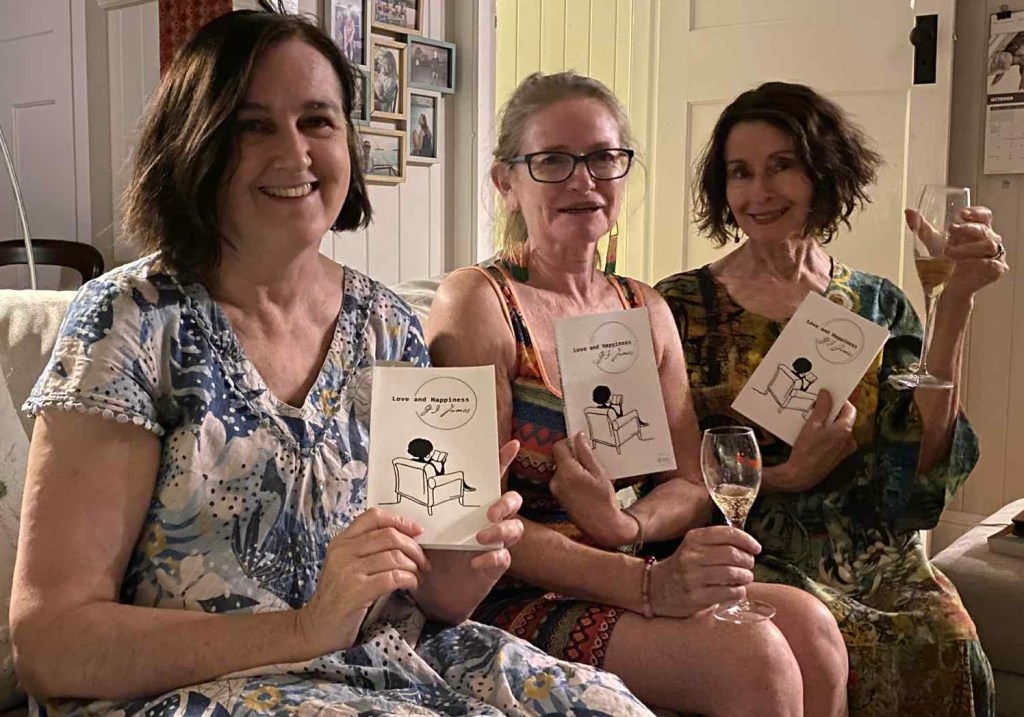
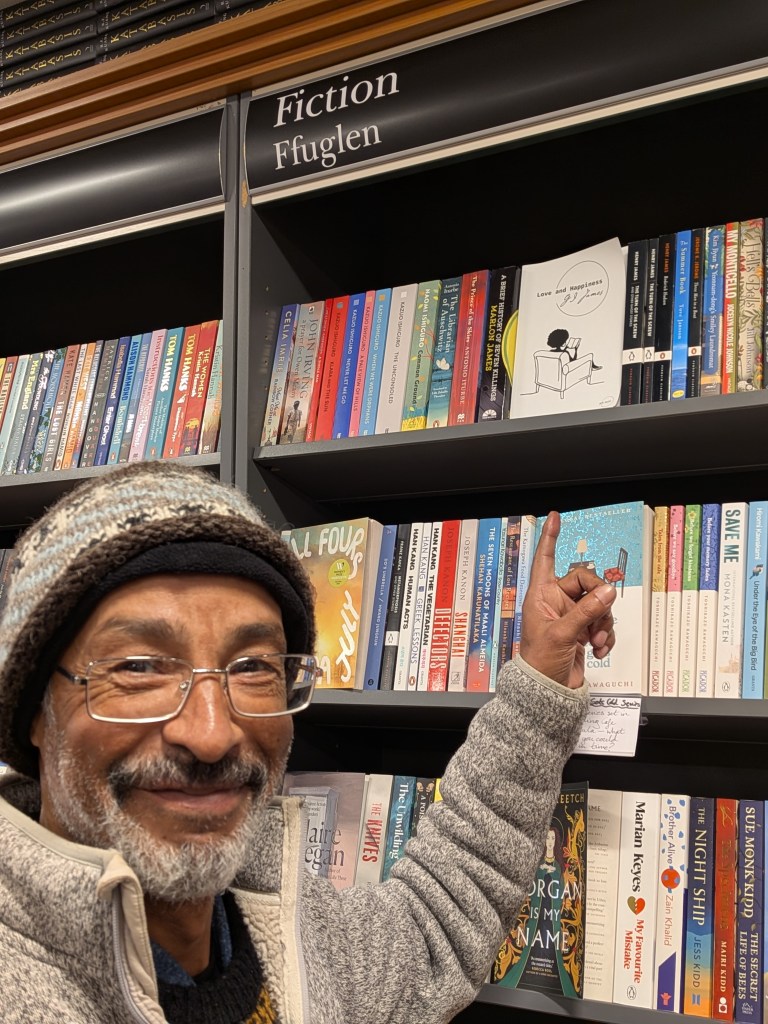
Love and Happiness by G.I. James: A punchy, sophisticated work of literary fiction. It deconstructs the complexities of the adoption experience and the lifelong quest for a sense of belonging. It is a debut that refuses to pull its punches.
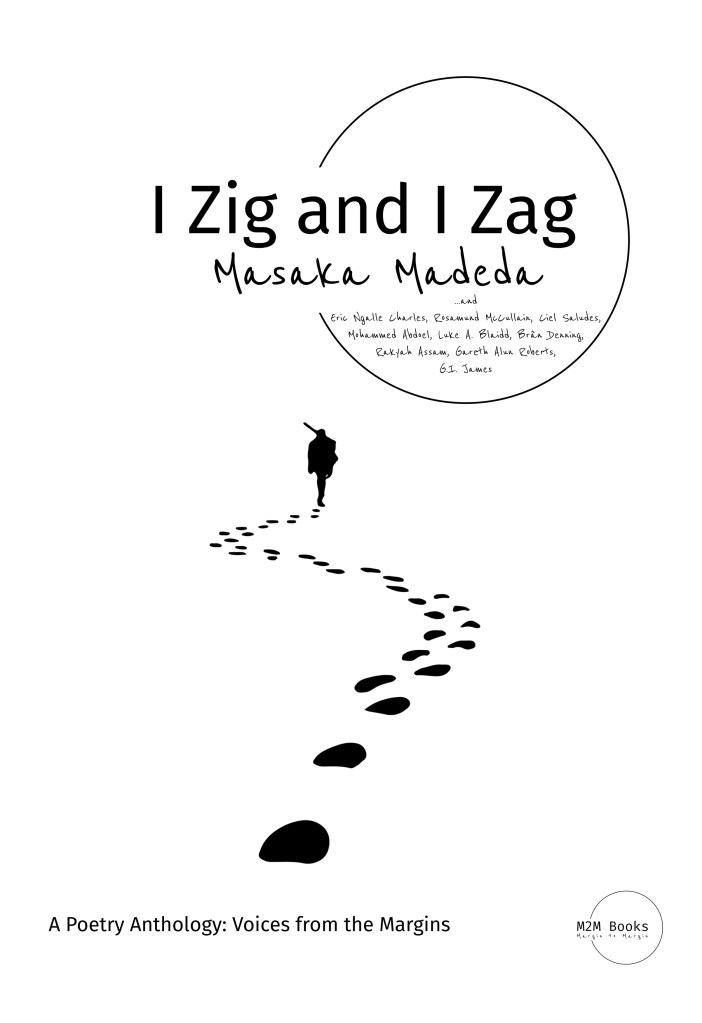
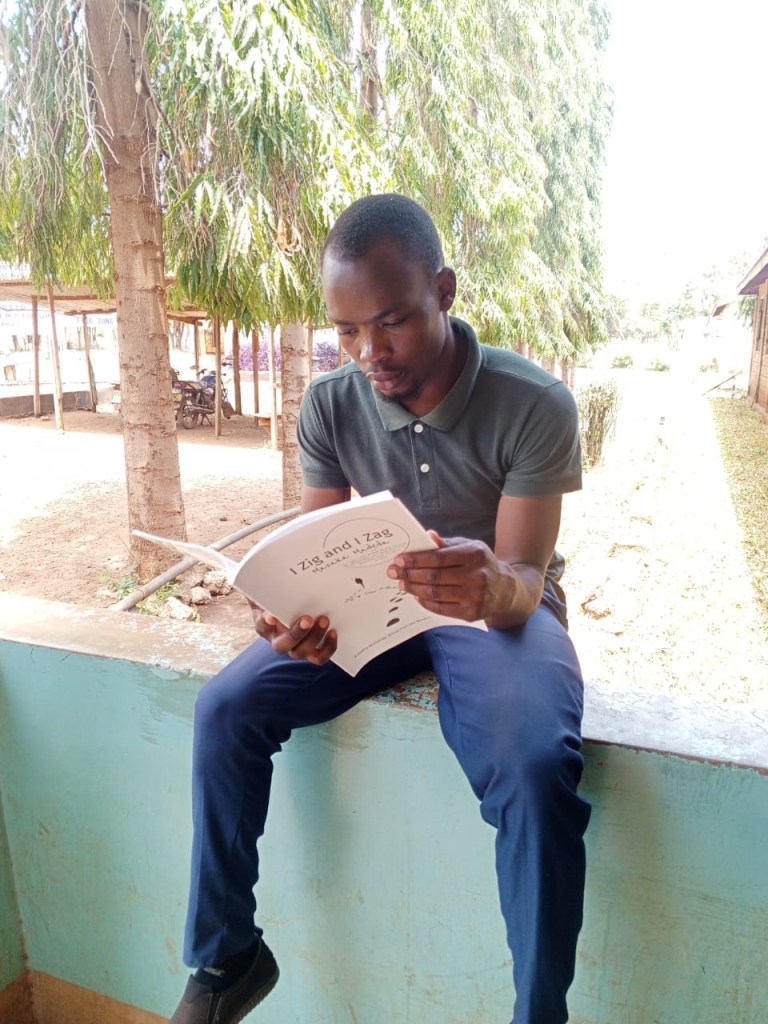
I Zig and I Zag: A vibrant poetry anthology that brings together a chorus of multi-community voices. A collection that is a testament to the zigzag nature of life on the margins—resilient, unpredictable, and beautiful.
Join Us
If you have an established platform and a dedicated following of readers who crave stories that move beyond the mainstream, we would love to collaborate with you.
We are offering a limited number of physical review copies for those who appreciate the aesthetic, as well as digital ARCs for our international friends or those who prefer to read on the go.
How to Request a Copy:
Please send an email to info@m2mbooks.com with the subject line “Review Request.” Please tell us:
Which title(s) you are interested in.
A link to your blog or social media platform.
Your preferred format (Physical or Digital).
As an independent press, we rely on the passion of the literary community to help these stories travel. We can hardly wait to hear what you think of the work.
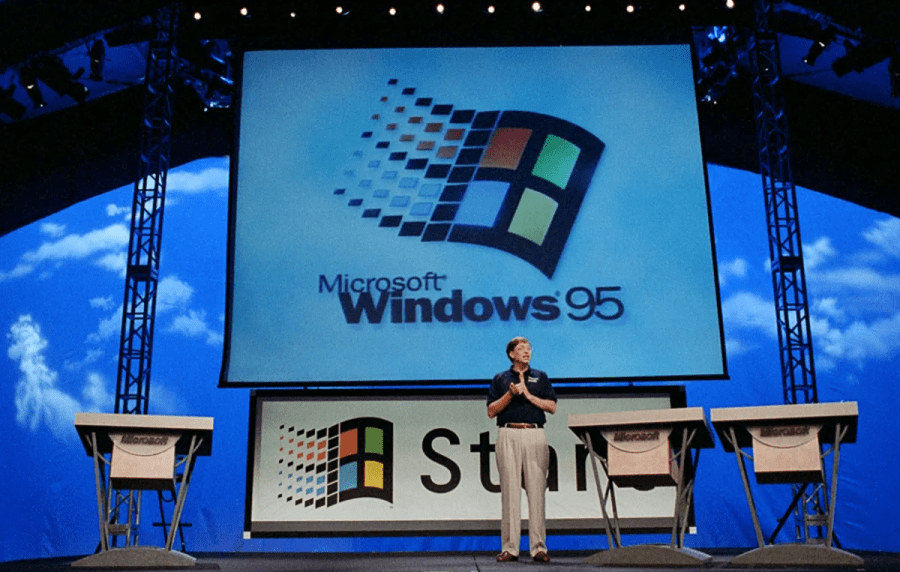
In 1995, the future didn’t arrive in a silver jumpsuit. No, the future arrived in a London hotel conference suite in the form of a diminutive young man who looked like he’d been dressed by a librarian working to a budget of nothing.
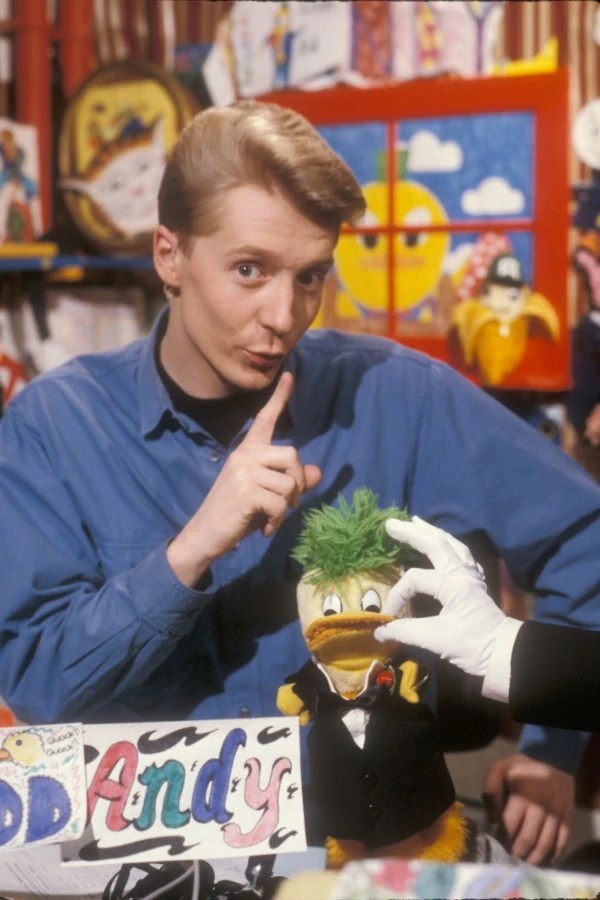
I had been tasked with booking the celebrity faces required to promote the UK launch of Microsoft Windows 95. Back then, celebrity was my business as well as an unhealthy national obsession (still is). I had assembled a glittering pantheon of British establishment icons: David Gower, the epitome of effortless cricketing grace; Angela Rippon, the poised voice of national authority; Jonathan Ross, the sharp-suited vanguard of ’90s cool. We had Carol Vorderman, the human calculator; children’s favourite Andy Crane; David Emanuel, fashion designer to British royalty. These guys were luminaries of the analogue age; high-def personalities who commanded the attention of a room simply by strolling in.
Then there was low-def Bill Gates. Underwhelming doesn’t quite capture the drabness. In a room full of people who were professionally charismatic, Bill Gates was a sartorial vacuum. He was the walking-talking cliché of a cardigan-clad nerd before the world realised that nerds were about to become the global aristocracy.
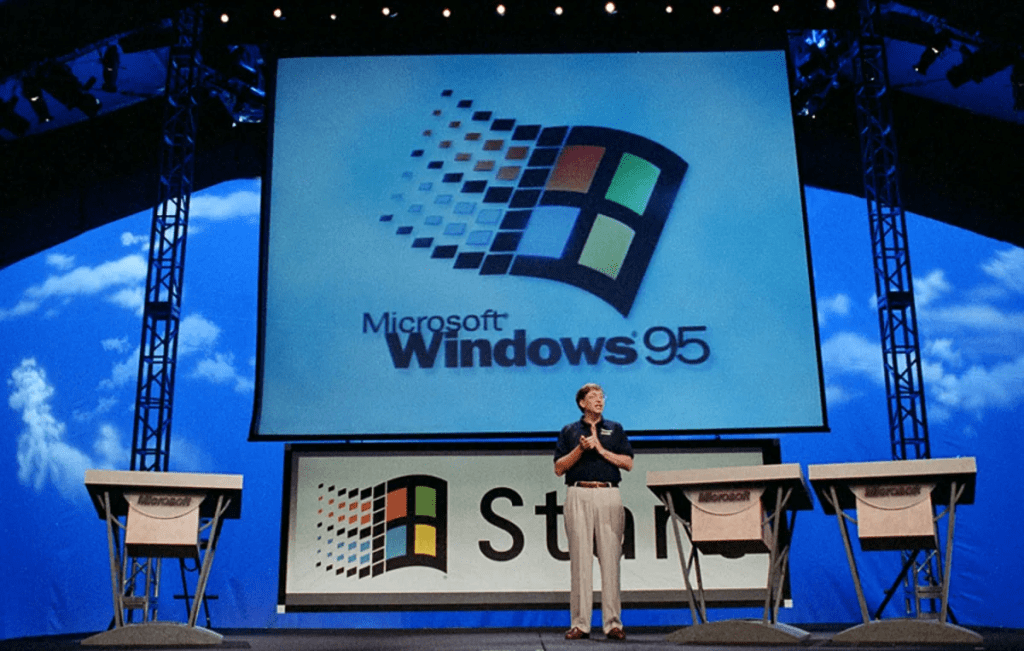
Bill Gates – Windows 95 launch
Bill Gates opted for tones of weak tea, or more accurately, a shade of diarrhoea-brown that seemed designed to blend into the podium’s furniture. The single nod to his success; the aspect of the man that will forever stick in my mind; an embroidered BG on the collar-tip of his badly pressed shirt.
Here was the wealthiest man on the planet, carrying himself with the disregarding confidence of a man who knew he owned the future. While my celebrities were the face of the present, the man in the beige trousers was the architect of their obsolescence. Bill wasn’t there to join our world; he was there to consign it to history.
A Failed Connection
Equally unengaging was Bill’s techno-spiel. Imagine sitting in a darkened room while a man with the nasal range of a dial-up modem explains that your life is about to change forever. Bill spoke of “e-messages” and a “World Wide Web”; an “information superhighway” that would allow an entrepreneur in Penzance to trade with a merchant in Manila.
At the time, all this sounded like pure science fiction. We liked Microsoft Word because it meant we didn’t have to use Tipp-Ex on our typewriters. But this Internet contrivance felt like a solution in search of a problem. In 1995, only Marks and Spencer, Barclays, and Littlewoods had websites, and even those were little more than digital posters. You couldn’t do anything with them. And since I didn’t bank with Barclays, the whole thing felt like a pipedream for people with too much time and money.
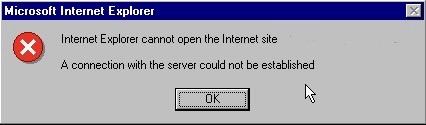
The demonstration itself was a comedy of errors. Tedious hours ground by as Bill droned on with his barely containable speculation about unlikely applications, predicting the whole world will soon be working this way, even though, with much clicking, he failed to secure any type of connection to this ‘internet’ contrivance he so commended. He clicked. He waited. The equipment declined to cooperate. We shuffled in our seats, hiding our smirks.
We were issued with exclusive @msn.com “e-message” addresses; pointless strings of characters because no one else in our universe had one. We could only communicate with each other, Microsoft employees, or Bill himself. We pocketed our considerable cheques and went back to our analogue lives; failing to realise we were witnessing the first, messy, stuttering heartbeat of the unrecognisable world we inhabit today, and blissfully unaware that the world we knew was about to be deleted.
Then Bill Gates was Dead Wrong
By the time the Windows 98 launch rolled around, Bill Gates wasn’t just a nerd anymore; he was a prophet billionaire nerd. When he spoke, the markets moved. When he pointed, the tech world marched. And at that time, he pointed confidently at the printer.
Bill’s prediction was that photo-quality printing would be the “next big thing.” He envisioned a world where every household would become a miniature Kodak lab. We’d all be sitting at home, whirring away, churning out glossy 6x4s of our holidays and Sunday roasts. He was dead wrong.
What Bill failed to see was that the screen itself would become the destination. The photo-quality display didn’t just compete with the printer; it murdered it. We didn’t want a physical copy of every fleeting moment; we wanted the instant, backlit gratification of the pixel. Your printer became a dusty relic, a temperamental box in the corner of the room that only comes to life when a boarding pass or a postage label is required.
Bill’s fallibility is important. It proves that while tech giants can build and develop, they don’t always know where the users will want to go. Bill thought the future was more paper. The reality was that we wanted less paper, but better quality.
Sitting on the Dock of the Bay – Wasting Time
Back to 1995. Armed with limitless free Microsoft software and a slightly nerdy streak, I undertook to waste some time building a pointless website for my celebrity agency.
But it wasn’t pointless; it was an apprenticeship I didn’t know I needed. Bill was right about the importance of the infrastructure, even if he missed the mark on the hardware. A few decades later, we all rely upon a web presence – even a little publishing house like M2M Books.
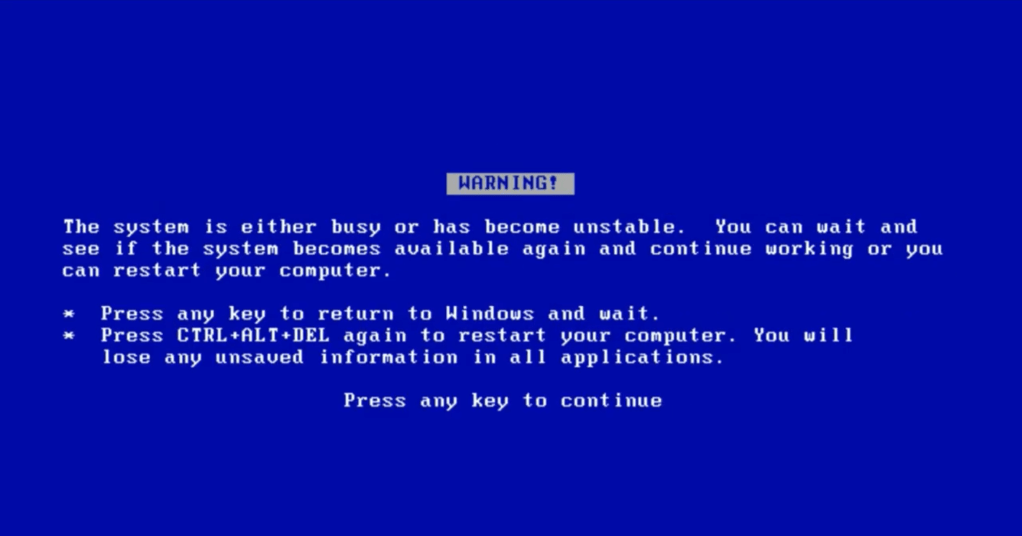
So, here I go again, editing and growing yet another website. It is a daunting prospect, but creating this content is proving considerably less taxing than the technical grapple of the mid-nineties. I don’t miss the blue-screen-inducing, instruction-manual-crunching nightmare of FrontPage 1.0. Code-editing back then felt like performing surgery with a blunt spoon, requiring the patience of a saint and the vocabulary of a sailor.
Blue Screen of Death 😭
Today
If Bill had been right about photo-quality printing, today’s world would be buried in a landslide of cheap, glossy nonsense. Instead, because the screen took over the disposable side of our lives; the news, the gossip, the quick snaps; fast-evolving technologies have left a sacred, more valued space for the material object. Good news for books!
So, being an independent press today means we don’t need to compete with the screen; we can complement it. I know you’re reading my words on a high-definition display that would have made 1995 Bill Gates weep with joy. But I also know that when you close this tab, you may want something in your hands that has weight, texture, and a soul. A book! Bill’s printer fallacy informed us that paper remains our preferred choice for literature.
M2M Books can operate as an independent press largely because Bill’s unlikely applications actually worked. The technology that seemed so ridiculous in that London hotel suite eventually dismantled the publishing gatekeepers. Back then, writers needed a massive corporate house to get a story told. Now, the artisan press thrives because we can bypass the usual suspects. We use the tools Bill pioneered to ensure that the analogue soul of a good book; the weight of the paper, the smell of ink, the craft of the word; can reach a global audience without needing a nod from a corporate giant. Bill might have been fallible about printers, but he gave us the keys to the kingdom.
Gareth James – Chief Reader M2M Books
Hope you like the new look website. It’s been a circuitous thirty years in the making 👍🏾 please subscribe and share👇🏾
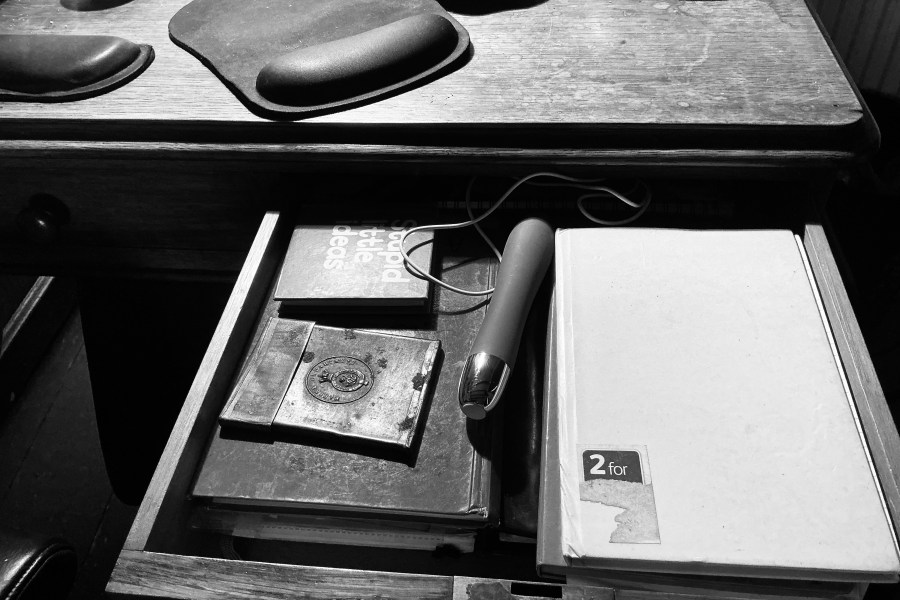
I’m a believer in a well researched approach to storytelling. If a character experiences something critical to the narrative, the author should, at the very least, understand the mechanics of said activity. However, being disappointingly unfamiliar with the modern landscape of sex toys, the following paragraph in Love and Happiness required an authentic understanding that only hands-on research would supply. To be honest, I have never anticipated manhandling a juddering jackhammer at eleven o’clock on a Tuesday morning, but such are the labours of a writer committed to the Art of Literature.
Harriet picks up her wand, twists the base, then twists to the second level. Oh, I see. An unexpected increase in intensity commands Harriet’s complete attention. She twists to a third level, grips the shaft in the palm of her hand. This now makes a lot more sense. She twists again, and as a numbing sensation creeps up her forearm, Harriet begins forming new plans for the remainder of the evening. She twists again, begins to fret, then twists to the maximum level. As Harriet struggles to retain control of the juddering jackhammer, her mind becomes entirely consumed in a whirlwind of absorbing ramifications and shocked disbelief.
Love and Happiness G.I. James
While the imagery of Harriet being physically overwhelmed by her new wand provides a moment of levity, the reality within the pages of Love and Happiness is far more poignant.
For Harriet, masturbation isn’t an act of hedonism, but an anaesthetic employed against mental distress. When the weight of Lucas’s chaotic life or the haunting echoes of her childhood become too loud to bear, she turns to the physical to silence her nightmares – a sensory overload designed to drown out the unmanageable realities of a life spent in the margins. In Harriet’s world, pleasure is a byproduct of her desperate need for silence.
Experience Harriet’s full journey in search of Love and Happiness.
Love and Happiness
👉 Order Love and Happiness – G.I. James, from your favourite bookseller or directly from m2mbooks.com
Our first year in business, establishing Margin to Margin Books as an independent press, has been nothing less than a baptism by fire. A period of steep learning curves, incredible highs, some losses, and the kind of mental and physical exhaustion that only comes from laying the foundations of something substantial.
As we battle into our second year, I’ve been reflecting on the hard lessons learned by M2M Books over the past twelve months. Here is the unvarnished truth about our one-year journey from novice publisher to literary infrastructure.
🥃vs📚 Reality Bites: Undoubtedly, the primary lesson and biggest eye-opener has been discovering that selling expensive rum to hollow-legged punters (my last job) is infinitely easier than selling books. A tenner for a decent drink? – that’ll do nicely! £9.99 for a fascinating book? – a far trickier proposition.
📖 The Physicality of the Craft: Our second hard lesson was a tangible issue: the covers of our first print run were beautiful, but too thin. My excuse, the cardstock samples arrived the morning after I’d pushed the print button. Without doubt, future editions and titles will all have heavier covers, so if you want to get your hands on these exclusive first editions, editions that will be worth fortunes in coming decades’ Antiques Roadshows, you’ll need to get a wriggle on.
👨🏾💻 The Irony of the Professional Reader: A bittersweet reality has been the loss of literary leisure. When my eyes are constantly scanning manuscripts for rhythm, structure, and submission potential, the commitment required to get lost in a book for the sake of it begins to evaporate. Furthermore, my own creative output has narrowed to essays and blog posts. My writing is no longer reactive and freewheeling; it has become limited to the machinery of this artisan press.
💰 Publishing – Difficult and Expensive: There is no easy mode when you are doing things independently. Publishing is not about sifting for books we want to publish, ideally, we would publish many more of the submissions we receive. Economic reality dictates that publishing revolves around deciding which few manuscripts we can afford to get behind and turn into physical books.
🚦Visible Pathways: The first year confirmed our core mission: the importance of providing a visible pathway to publishing for marginalised voices. For many writers from marginalised communities, the literary world feels like an impenetrable fortress. By being an independent press that is active, vocal, and accessible, we show underrepresented writers that there is a seat at the publishing table for them.
👴🏾 Hard Truths: I’ve also had to face a personal reality: I’m no spring chicken and don’t have quite the same energy I used to. But this isn’t a sprint; it’s a marathon that requires careful pacing and a clear-eyed view of one’s own limits – exactly the same process as writing a book.
🏝️ No Project is an Island: Success in the publishing industry cannot happen in a vacuum. Success is won through partnerships (like our growing relationships with Aberystwyth UNESCO City of Literature, Books Council of Wales, Literature Wales, The Cambrian News, the National Library of Wales), through the support of our readers, through bookshops like Ystwyth Books and Waterstones, and through the amazing community of writers who trust us with their work. We are part of a powerful and fast evolving ecosystem, and we thrive when we support one another.
Looking Forward: We’ve absorbed these lessons; the thin covers, the importance of partnerships and providing pathways, the late nights; and are now fully focused on pouring all this hard-won wisdom into M2M Books’ future titles.
Support the project by grabbing an exclusive ‘thin-covered’ first edition of I Zig and I Zag and Love and Happiness. Buy from your favourite bookshop and online (Kindle editions available📱).
Following the successful launch of our debut collection, I Zig and I Zag, Margin to Margin Books is excited to announce an open call for submissions for our second multi-community anthology. Provisionally titled Margin to Margin, this collection seeks to amplify a range of voices from the literary periphery.
What We Are Looking For
For this second volume, we are expanding our horizons. While poetry remains at the heart of the project, we are also opening the door to prose. We invite submissions that speak to Marginalised Communities in the following categories:
Poetry: Bold, beautiful, unfiltered.
Short Stories: Narrative fiction exploring the complexities of identity and place.
Essays: Personal reflections, social critiques, and lived experiences.
While the M2M Books submission window remains permanently open for future projects, there is a specific cut-off for this upcoming volume:
Submission Deadline: Friday 13th March 2026.
Anticipated Publication: Late Summer 2026.
Get Inspired: The M2M Books Spirit
If you want to understand the spirit of our independent press, look no further than our first anthology, I Zig and I Zag.
Published in September 2025, this multi-community poetry collection is available in bookshops across the UK. To help our global community of writers and readers access these voices, we have a special limited-time offer running: download the Kindle edition of I Zig and I Zag for just £3.99 (offer ends Wednesday, 14th January 2026).
“Our job is to bridge the gap between those writing from the margins and those readers from marginalised communities searching for stories that feel like home.”
Gareth James, Chief Reader M2M Books
How to Submit
We want to read your poetry, your narratives, and your experiences – your story told your way.
‘She might not be Jamaican,’ says Jackie. ‘They’re both adopted. They’re not related, not like that, not by blood I mean.’
‘Oh, what’s that like?’ asks someone.
‘It’s like this,’ says Harriet, not looking up from her napkin folding.
Love and Happiness p.69
What is adoption like? I suspect there are as many different experiences as there are adoptees. I can only tell you about mine—the perspective of a 61-year-old, mixed-race adoptee who has found that time does not heal, that the experience of trans-racial adoption only grows more complicated as the decades whizz by.
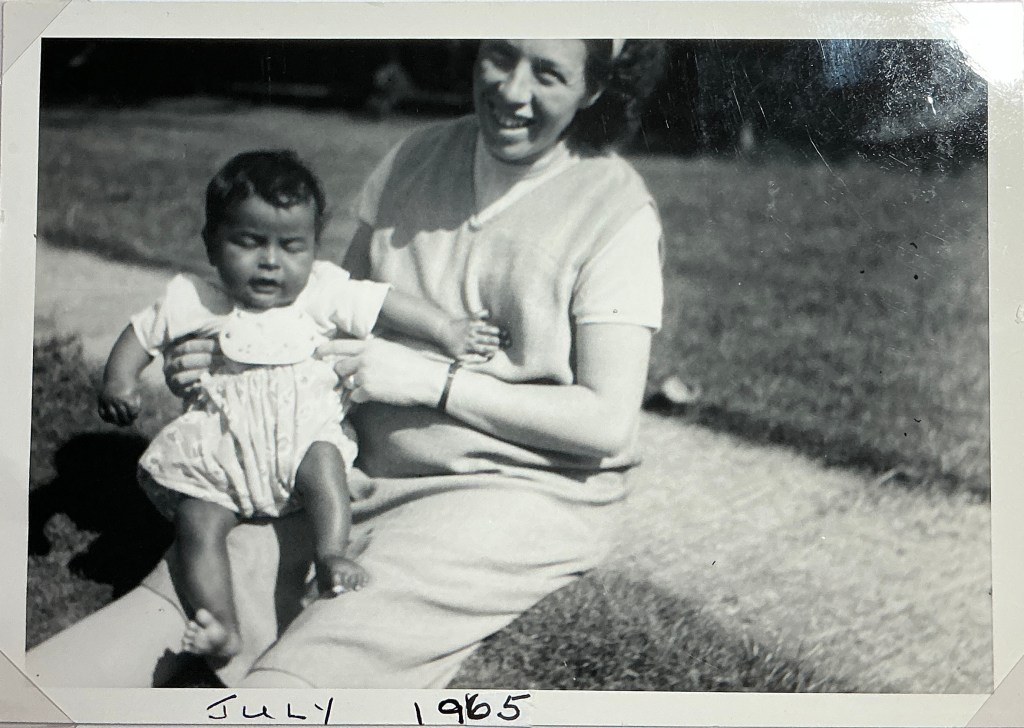
I arrived at my adoptive home, ten days old, with little more than a few naive leaflets and a good-luck wave from the social worker. My well-meaning parents were left entirely to their own wit and wisdom. I was fortunate; they did as good a job as they could under circumstances in which their best efforts would never be enough.
My parents’ valiant efforts could never be enough because I emerged into consciousness with a tragically resolved reality: given up by one family to be taken in by another. Rejection, abandonment, etched into my backstory before I could even speak. And this lifelong awareness of that initial abandonment indicated an unsteady, untrustworthy world and moulded a child who overcompensated, who required regular reassurances of love, loyalty, and praise.
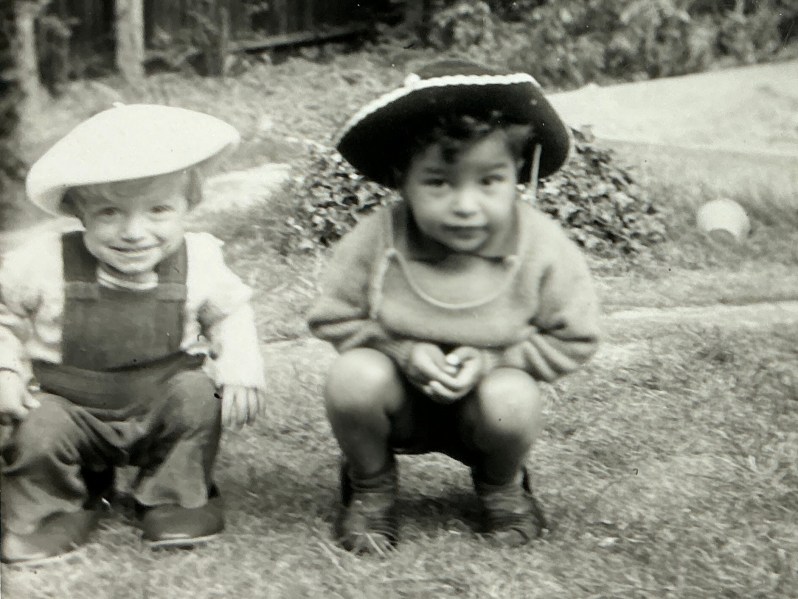
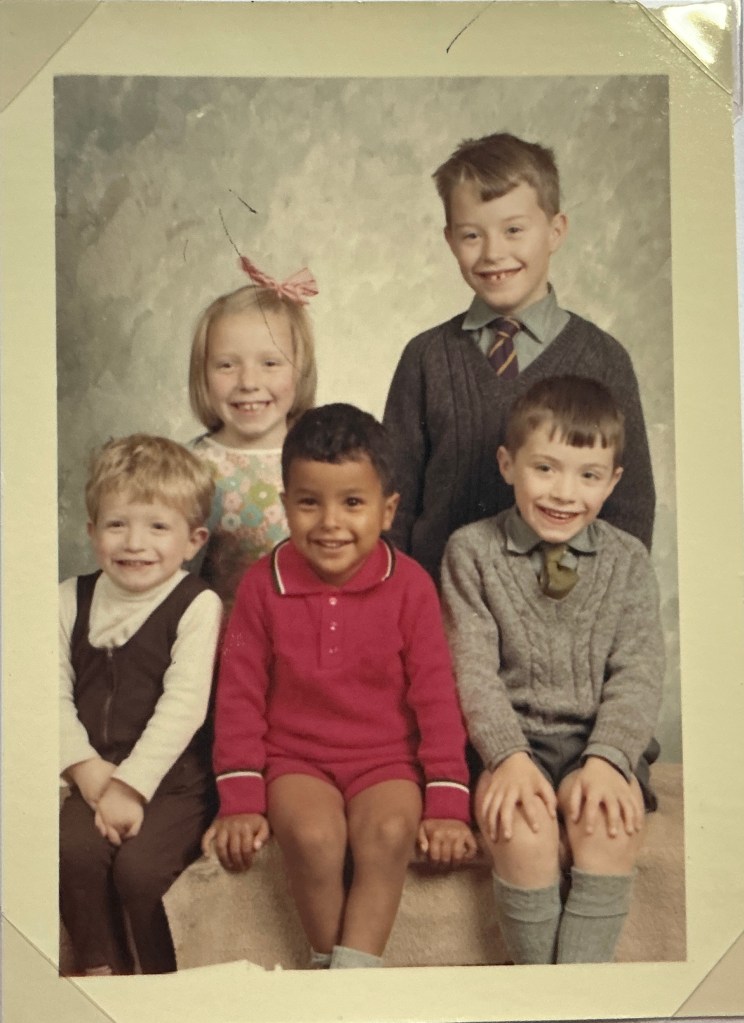
I had older, and then younger siblings, and felt as loved as any of them. Adoption was spoken about and normalised in our everyday discourse. Growing up as a brown baby in a white family, there was no big reveal. You can’t hide that kind of truth. Yet, I can only surmise that the underlying trauma of being given away never really left my developing head-space.
I have never sought out my birthparents. I understand that knowing where I came from would fill a multitude of unresolved holes in my life, but I have simply never been brave enough to risk putting myself through that level of rejection for a second time.
The way I see it, I was left behind on a metaphorical platform while my family’s train departed the station. That was never okay with me, and I’m not sure what could be said now that would make me understand why it happened.
My sense of abandonment by my birth family is intensified by the social attitudes of 1964. It is impossible to discount the racial element of my instant rejection; a picture of a white family urgently divesting themselves of their daughter’s brown baby. Bastards!
This unavoidable racist narrative is made even more painful by the knowledge that white babies put up for adoption were considered premium, reserved for childless white couples. Black or brown kids, like myself, went to adopters who already had children, and were often offered in pairs. These are heavy, complicated realities to absorb.
Having my own children complicated these feelings further. Meeting my children; my first and only encounters with blood relatives; has made the very concept of adoption feel even more alien to me. Adoption feels like a Western-European cultural anomaly that I am still failing to get my head around. No resolution. No happy ending.
I wrote a novel, Love and Happiness, to explore these unresolvable shadows. It isn’t a safe story, because adoption isn’t a safe experience. Writing Harriet and Lucas’s adoption story didn’t serve to soothe my pain. It’s too late for that – hard knocks leave dents. So, Love and Happiness is an exploration of scenarios, of possibilities, a pacy, raw look at a search for belonging in a world that feels unsteady in its foundations and uncertain in the relationships it offers.
Love and Happiness is the story of two brown babies left to find their own way in a white world. Tracing their journey from juvenile fantasy to the adolescent dawn of an uncomfortable reality, and finally, to a more mature, but equally traumatic reflection.
If you have spent your life navigating the unresolvable holes left by the departure of your birth family, I would value your perspective in the comments. And how has your take on adoption shifted as the decades have whizzed by?
G.I. James – author: Love and Happiness
Love and Happiness by G.I. James is available in UK bookshops. ❗️Special Ebook Offer❗️Kindle edition £4.99 £1.99 – offer ends 14 January.
At M2M Books, our mission for 2026 is set: we exist to publish great writing for marginalised audiences and to amplify authentic voices who refuse to perform for mainstream expectations. We are an artisan press who also understands the value of a well-curated digital library.
The Invitation
To celebrate the beginning of our second year of operation and our new creative home in Taliesin, we are opening a seven-day discount window to make our flagship titles more accessible to our global community.
🌍 International Readers: We know shipping physical copies overseas is a challenge. By lowering the price of our Kindle editions, we are offering our global community a frictionless way to access the M2M Books catalogue. Whether you are in Nairobi or New York, you can download these titles instantly at the same special rate 🇰🇪🇺🇸
From 8:00 a.m. today, Wednesday 7th January, until Wednesday 14th January, we have lowered the barriers for everyone.
The Featured Titles
• Love and Happiness – G.I. James (£1.99/4.99) A pacy exploration of the destructive nature of adoption and the relentless pursuit of identity. This is a debut novel for those who understand what it means to search for belonging in an untrustworthy world.
• I Zig and I Zag – Poetry Anthology (£3.99/9.99) An essential multi-community collection bringing together an extraordinary chorus of poets. This anthology invites you to embrace the zigzagging pathways of life, finding value in the margins we all encounter.
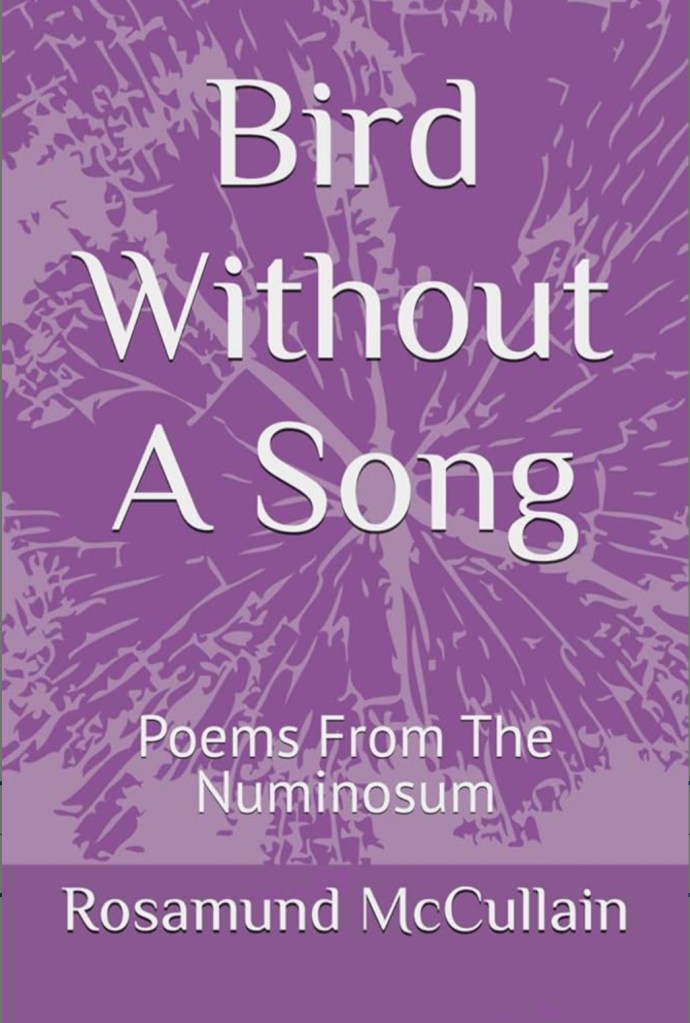
When you purchase a title from an independent press, you aren’t just buying a file or a stack of paper; you are facilitating the next project. You are ensuring that unique voices like Masaka Madeda, Eric Ngalle, and Rosalind McCullain have a platform that isn’t dictated by mainstream expectations or the diversity calendar.
This isn’t a clearance sale. This is our calculated move to get these important new stories into as many hands as possible as we begin an exciting new chapter. So please share this opportunity.
How to Join the Library
You can take advantage of these special discounts via Kindle. The window closes in seven days.
At Margin to Margin Books, we understand that an independent publisher is only as strong as the community that surrounds it. The small press industry doesn’t have the massive marketing budgets of large publishers – but we do have you. And you have a vital role to play.
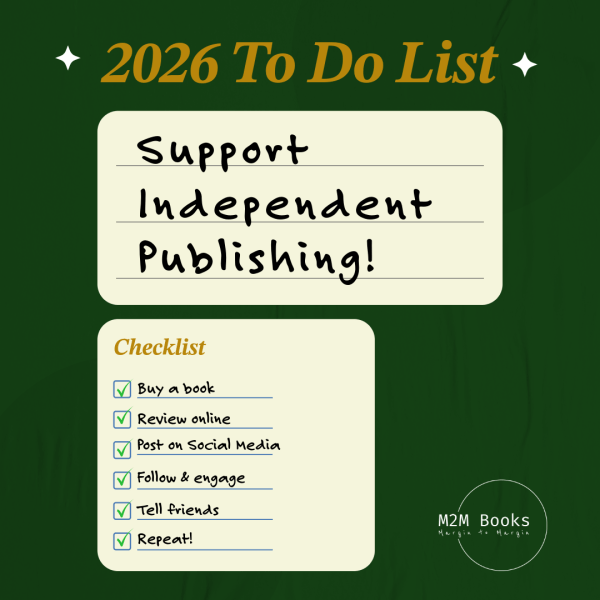
Here are five ways you can help independent publishing:
1. Buy a book published by an independent publisher
The most direct way to support the mission is to vote with your wallet. Every book bought from a small press like Margin to Margin Books is a direct investment in future titles and the authors that will compose them. Your purchase helps facilitate the next independent project. But buying a book is only the beginning of your key role.
2. Read and review (Amazon, Goodreads, and beyond)
In the digital age, reviews are the lifeblood of independent titles. If you’ve read a good book from an independent publisher, please take five minutes to leave a review on Amazon, Goodreads, StoryGraph, or anywhere. Your reviews inform algorithms that these stories matter, helping independent publishers reach more readers who are tired of predictable mainstream offerings.
3. Post about the book online
You don’t need to be a pouting influencer to make a difference. A simple photo of your current read on Facebook, Instagram, TikTok, X, or Bluesky helps spread the word far beyond our own reach. Tag M2M Books; we love to see our titles out there in the wild.
AustraliaKenyaAberystwyth
4. Follow us and talk to us
Independent publishing is about connections. Follow us on social media, reply to our posts, join the conversation. We want to hear from the communities we are publishing for. When you engage with M2M Books, you’re helping maintain the important literary dialogue that keeps independent publishing vibrant and relevant.
Word of mouth remains the most powerful tool in literature. If a story resonates with you, tell a friend; recommend it to your local book club. By sharing these titles, you are helping to build a stronger independent publishing sector.
Independent publishing is not a solo project; it is a collective effort. Help make 2026 the year the independent voice becomes impossible to ignore.
I am famously agnostic about Christmas; never been one for tinsel and forced seasonal sentimentality. Not enticed by New Year’s Eve; the noise and the performative countdowns; seen it all before. But I still get super-excited by the first working day of each New Year – a motivational springboard of intent. Happy New Year!
So, while most of the rest of the world remains in recovery mode, I have already flipped open this new year like the first page of a brand new notebook (so fresh and so clean clean). Energised by the potential of many unknowable narratives that will be etched into reality over the coming twelve months.
A massive drawer marked “January”, for the past few months, has been a convenient vessel to shove many arduous tasks into. Ambitious ideas, complex manuscripts, and every “we’ll get to that” email, hidden away for a later date. Today (cos it feels like a Monday), that drawer has been tipped onto my desk, set out neatly, ready to be engaged with.
📚 Looking Back – Moving Forward
The final months of 2025 were a whirlwind of activity for M2M Books:
• The Launch: We brought into the world our first multi-community poetry anthology, I Zig and I Zagby Masaka Madeda alongside other diverse poets, and debut novel, Love and Happiness by G.I. James; a pacy narrative exploring adoption and identity that has already begun to resonate.
• The Transition: We bade a fond farewell to Irie’s Bar; a space that fuelled our early energy; and have transitioned our operations to Taliesin. This move represents a shift into a more focused, dedicated environment where we can nurture the next wave of M2M Books’ authors and titles.
• Our Digital Home: We revamped our publishing website m2mbooks.com. We stripped away our necessarily hurried first attempt to create a boutique space that better reflects the quality of our authors.
💪🏾 Hopes for 2026: Publishing beyond the diversity Calendar
Throughout 2026, the M2M Books’ mission is to encourage writers from diverse backgrounds to move beyond the diversity calendar; to compose texts for their own communities; to resist defaulting into explanation and performative suffering for largely disinterested mainstream audiences.
This year is about building permanent internal libraries for a range of marginalised communities. We want to publish more books that uplift communities and refuse to fit into any predictable mainstream box.
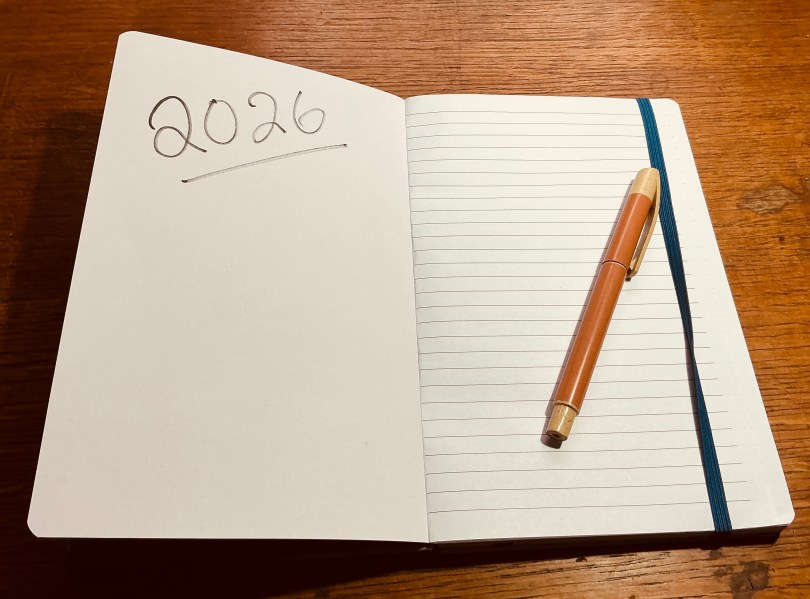
The desk is set, the notebook is open, the pen is poised. Let’s get to work.
✍🏾 Join the Journey
If you have a manuscript that belongs on our desk – a story, poetry, or nonfiction written for a marginalised community – our submission window is always open.
Marginalised writers are customarily employed as a form of seasonal window dressing. There is a month for every identity, a short period when a few representative authors are invited to perform their trauma for a curious public; a fleeting moment when the publishing industry undertakes a desperate bit of box-ticking and then reverts to its default settings. This is not a picture of positive publishing; this is opportunistic virtue signalling.
M2M Books has no interest in tokenistic diversity calendars; not interested in marginalised communities being offered up to the mainstream as seasonal decoration; consigned to the loft for the majority of the year; writers finding themselves exactly where they were before the brief flurry of activity; out of sight, out of mind; exposed and unsupported; publishers immediately racing on to the next marketable trend.
And in these occasional periods when publishing houses appeal for diverse manuscripts, they are often looking for a specific kind of trauma narrative composed for the Hay Festival demographic. They want to publish the Racism or Homophobia 101 explanation; a comfortable self-serving product drafted for the gaze of the well-meaning liberal. Literature of misery and existential justification.
So, while the industry awaits the next political trend to dictate what is marketable, our mission remains fixed. M2M Books is committed to curating robust literary infrastructure for a spectrum of marginalised audiences – an Internal Library that will remain available and active 365, year after year after year.
This is why our submission window does not close when a heritage month ends. Our submission window remains permanently open; the urgent need for the literary fortification of under-represented communities does not have time for an off-season.
What Submissions are M2M Books Looking For?
We prioritise the complex, the authentic, and the internal; literature that will resonate with marginalised communities, rather than books that beg the world for permission and understanding. We want to publish fiction, nonfiction, and poetry that offer solace, resilience, and intellectual armour to our various marginalised communities in an increasingly hostile political climate.
Sanctuary for the Serious Writer
If you are a writer who is tired of being treated like a seasonal guest, a case study, spokesperson, or representative of your community, M2M Books is your sanctuary. We are not looking for your anger or suffering to be used as an educational tool for others. We are looking for your literary craft to be deployed as fortification for your own community.
This important work continues. We are building something permanent. We are building for ourselves.










 Margin to Margin Books